
The Big Data Institute of Vintech (Vingroup) has announced the project “Building a database of genetic variation of the Vietnamese population”. With an investment of up to USD 4.5 million, the research aims to create a database for early warning and treatment of some diseases, and to help develop diagnostic and treatment methods tailored to each individual. This is the largest genome project in Southeast Asia to date.
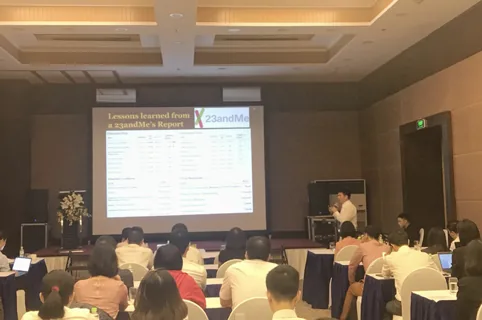
The information was announced by the Big Data Institute at an international biomedical research workshop attended by overseas Vietnamese-American scientists, held early this week in Hanoi.
Accordingly, Vingroup will invest USD 4.5 million in the project “Building a genetic variation database for the Vietnamese population”, based on sequencing the whole genomes of 1,000 people. At this scale, the project will create the largest genetic variation database to date and provide a foundation of data for research on Vietnamese genes for the research community at home and abroad. The research will start in early 2019 and last five years.
In the first three years (phase 1), scientists will collect samples from 1,000 Vietnamese people and work with international partners in the US, Germany, Singapore and Japan… to sequence and analyse whole genomes at high coverage, and from this build the genetic variation database for the Vietnamese population.
From this database, scientists will build further reference variant lists (panels) to support genome-wide association studies, studies of genetic diseases and pharmacogenomics (PGx). The genome data after high-coverage sequencing, together with the analysed data, will require hundreds of terabytes of storage. To support the research, Vingroup will also invest in modern analysis systems and big-data storage systems to meet these analysis and storage needs.
Prof. Vu Ha Van, Scientific Director of the Big Data Institute, emphasised: “This is not only a premise for research in phase 2 but also a foundation for other genetic research in Vietnam. Because of the complexity and the large funding required to build a genetic database, the project will make a great contribution to the research community working on gene-related issues in Vietnam”
In phase 2, the project focuses on genome-wide association studies to develop testing methods for some genetic diseases and adverse drug reactions.
The project’s research team has been working with genome and genetic disease researchers in the US, Germany and Japan… In the PGx field, the team is also working with research groups in Southeast Asia on the “1,000 Pharmacogene Resequencing” project, in which Singapore, Thailand and Japan are pioneers in applying PGx in clinical practice. To sequence and analyse whole-genome data at high coverage for thousands of genomes, the project also works with experts at home and abroad and applies Illumina’s next-generation sequencing technology.
Carrying out these projects in connection with foreign experts will help build a domestic team for biomedical, genomic and data science research and give access to the latest research methods and data analysis techniques to international standards.
Building and analysing the human genome has a major impact on many fields, most notably medicine, pharmacology, biotechnology and anthropology. In particular, genetic research leads to discoveries, warnings and early treatment of some diseases, and helps develop diagnostic and treatment methods tailored to each individual (personalised medicine). The project will therefore have a very large social impact.